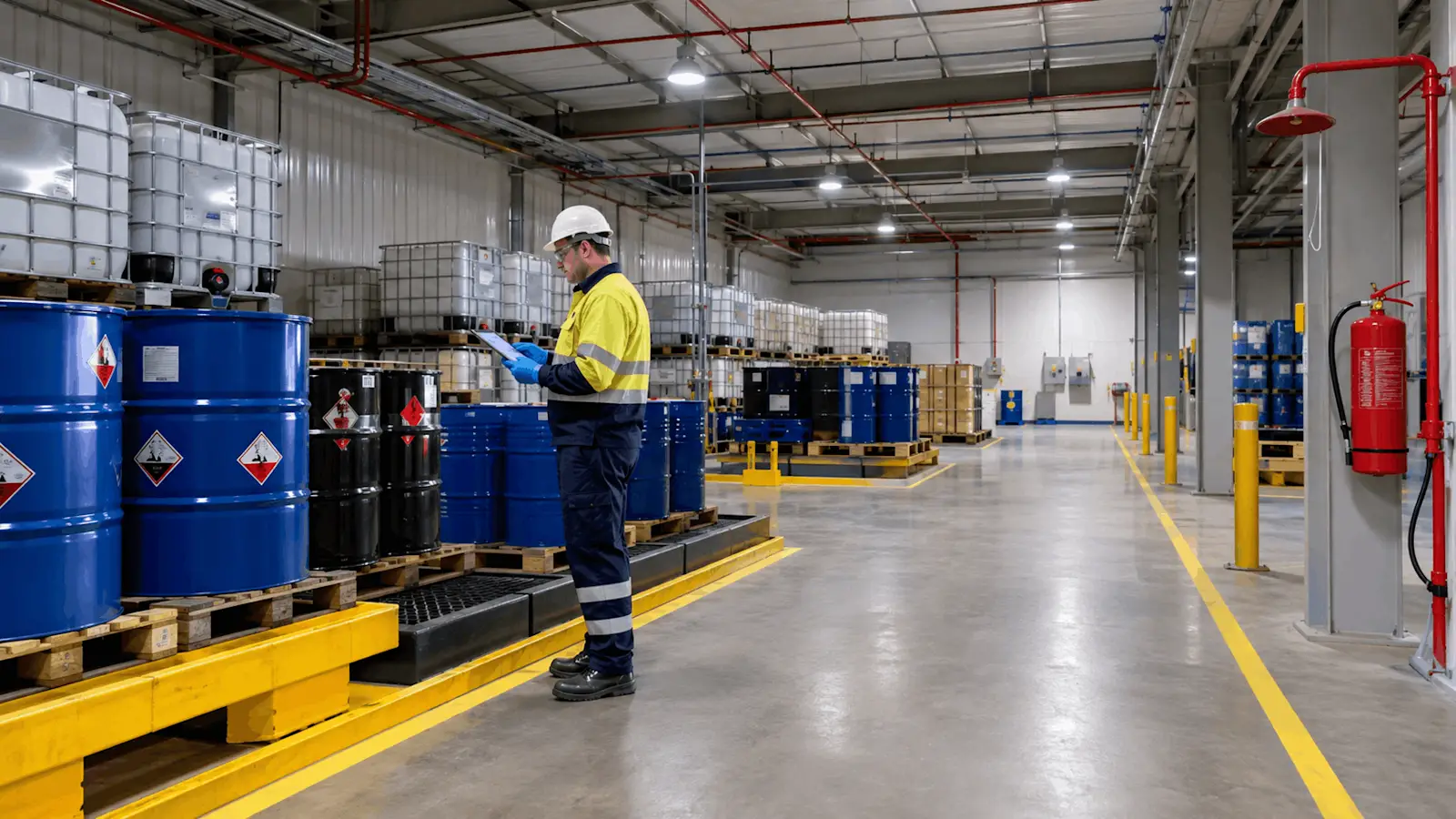
HazMat Storage in a 3PL Warehouse: What the Regulations Actually Require
August 16th, 2026
Most warehouses store general freight. A much smaller number are equipped, certified, and operationally built to store hazardous materials. The difference between those two categories is not visible from the outside, which is precisely what makes the wrong choice so costly.
A facility that accepts hazardous materials without the right infrastructure, training, documentation systems, and regulatory compliance does not just expose itself to liability. It exposes every business storing product there to the same risk, because a single compliance failure in a mixed-use facility can affect everything stored in it, regardless of whether that product is itself hazardous.
For businesses that manufacture, distribute, or import products classified as hazardous materials, the choice of storage partner is a compliance decision as much as a logistics one.
Understanding what genuine HazMat warehousing compliance actually requires is the starting point for making that choice safely.
What Qualifies as a Hazardous Material for Warehousing Purposes
The list of products that fall under hazardous materials classification is broader than most businesses initially expect. It is not limited to industrial chemicals or explosive materials.
Many everyday commercial products are classified as HazMat under federal regulations, including aerosols, cleaning agents, paints and coatings, automotive chemicals, certain cosmetics and personal care products, and lithium batteries.
The DOT Hazardous Materials Classification System
The Department of Transportation classifies hazardous materials into nine primary classes, each covering a specific type of risk. If a product falls into any of these categories, it requires hazardous materials handling throughout its storage and transportation lifecycle.
Class | Type | Common Examples |
Class 1 | Explosives | Fireworks, ammunition, airbag inflators |
Class 2 | Gases | Propane, aerosols, compressed oxygen, toxic gases |
Class 3 | Flammable and combustible liquids | Paints, solvents, adhesives, fuels |
Class 4 | Flammable solids and reactive materials | Matches, certain metals, materials dangerous when wet |
Class 5 | Oxidizers and organic peroxides | Bleach, hydrogen peroxide, chemical fertilizers |
Class 6 | Toxic and infectious substances | Pesticides, certain pharmaceuticals, medical waste |
Class 7 | Radioactive materials | Medical isotopes, industrial gauges |
Class 8 | Corrosives | Battery acid, cleaning compounds, certain industrial chemicals |
Class 9 | Miscellaneous hazardous materials | Lithium batteries, dry ice, magnetized materials |
If there is any uncertainty about whether a specific product qualifies, the product's Safety Data Sheet is the authoritative reference. A responsible HazMat 3PL warehouse will always request SDS documentation before accepting a product, and a provider that skips that review is a compliance red flag.
The Core Regulatory Framework for Hazmat Storage
HazMat warehousing operates under a multi-agency regulatory framework, with different bodies governing different aspects of storage, handling, transportation, and environmental protection. A compliant HazMat facility does not simply meet OSHA's requirements. It meets all four primary regulatory frameworks simultaneously.
DOT: Transportation and In-Transit Storage
The Department of Transportation governs the movement of hazardous materials under the Hazardous Materials Transportation Act, including requirements that apply to storage during the transportation process.
DOT regulations specify packaging requirements, labeling and placarding standards, documentation requirements for shipments, and the qualifications that drivers and handlers must hold before moving regulated materials.
A 3PL HazMat facility with transportation capability must maintain certified drivers, proper placarding, and detailed route planning to meet all DOT requirements on every outbound movement.
OSHA: Worker Safety and Chemical Handling
OSHA's Hazard Communication Standard requires that hazardous materials are labeled correctly with GHS-compliant pictograms and hazard classifications, that Safety Data Sheets are maintained and accessible for every chemical stored in the facility, and that all employees who handle hazardous materials receive appropriate training.
OSHA also sets specific requirements around the storage of flammable and combustible liquids, including restrictions on quantities that can be stored outside approved containment structures and requirements for fire-rated storage containers.
EPA: Environmental Protection
The EPA enforces regulations focused on the safe storage and transportation of hazardous waste, including management and disposal requirements that apply when HazMat products reach the end of their useful life or are damaged in storage.
EPA regulations are particularly relevant for facilities storing corrosives, reactive materials, or substances with potential for environmental contamination if a spill or containment failure occurs.
NFPA: Fire Safety Standards
The National Fire Protection Association sets guidelines and codes for fire safety in HazMat storage environments, covering fire suppression system requirements, segregation of incompatible materials, ventilation specifications, and the physical construction standards that HazMat storage areas must meet.
NFPA compliance is not optional alongside the federal regulatory frameworks. It is a prerequisite for operating a HazMat warehouse safely.
What a Genuinely HazMat-Capable Warehouse Must Have
Meeting the minimum regulatory requirements is a baseline, not a guarantee of operational competence. A warehouse that is technically compliant on paper but has not built HazMat operations into its daily culture creates risk that compliance documentation alone cannot prevent.
Physical Infrastructure Requirements
Dedicated segregated storage zones: Hazardous materials must be physically separated from general inventory and, critically, from incompatible hazard classes. Incompatible materials stored in proximity to each other can cause fires, toxic reactions, or explosions in the event of a containment failure. Dedicated zones with appropriate separation distances are a non-negotiable physical requirement.
Secondary containment: Spill containment systems, including sumps, bunds, or dike structures, must be capable of capturing the full volume of the largest container stored in that zone. Containment systems prevent spills from migrating to drainage systems, soil, or nearby water sources.
Fire suppression systems: Appropriate fire suppression infrastructure, including sprinkler systems calibrated for the specific hazard classes stored in the facility, is required under NFPA standards. The type of suppression system required varies by hazard class, which is why a general warehouse fire suppression system is often not appropriate for HazMat storage.
Ventilation: Adequate ventilation prevents the accumulation of toxic vapors or flammable gases in the storage environment. Ventilation systems in HazMat areas must be designed for the specific materials stored there, with classified electrical equipment to prevent ignition sources in areas where flammable vapors may be present.
Documentation and Training Requirements
Safety Data Sheets: Every product stored in a HazMat facility must have a current SDS on file and accessible to all personnel who handle it. SDS documentation must be maintained and updated whenever a new product enters the facility.
Staff training: Employees who handle hazardous materials must receive documented training covering hazard identification, proper handling procedures, emergency response, and the specific requirements for each hazard class they work with. Training records must be maintained and available for regulatory inspection.
Shipment documentation: Every HazMat shipment must be accompanied by correct documentation including proper shipping name, hazard class, UN identification number, packing group, and emergency response information. A 3PL HazMat facility generates and maintains this documentation as part of every outbound movement.
The Compliance Questions to Ask Before Choosing a HazMat Warehousing Solutions Partner
For businesses evaluating HazMat warehousing solutions, the following table cuts through the surface-level facility tour and gets to the compliance information that actually matters:
Question | What to Look For |
Which hazard classes is the facility certified to store? | Specific class certifications matching your product classifications. Not all HazMat warehouses cover all nine classes. |
What segregation protocols are in place for incompatible materials? | Physical distance and barrier requirements between incompatible hazard classes, documented and enforced operationally. |
What are the secondary containment specifications? | Containment capacity sufficient to capture the full volume of the largest single container in the storage zone. |
What is the staff training program and how is it documented? | Formal, documented training records updated regularly, available for regulatory inspection on request. |
How are SDS documents maintained and accessed? | A systematic digital or physical SDS management system, not a paper binder that may or may not be current. |
What is the emergency response protocol? | Written emergency response procedures covering spills, fires, and chemical exposures, with staff who have practiced them. |
Is HazMat storage a dedicated function or a general warehousing add-on? | A dedicated HazMat facility has built its entire infrastructure and training culture around regulated materials, not adapted a general warehouse to accommodate them. |
Why Dedicated HazMat Warehousing Reduces Liability for Your Business
The liability case for using a specialist HazMat facility rather than a general warehouse that accepts regulated materials comes down to one principle: a compliance failure in a mixed-use environment affects everyone in it.
When a general warehouse stores HazMat alongside conventional freight, a spill, fire, or regulatory violation does not stay contained to the hazardous materials zone. It can affect the entire facility, every product stored in it, and every client whose inventory is there.
The regulatory consequences of a compliance failure, ranging from facility closure to six-figure EPA or OSHA fines, can disrupt a business's entire supply chain regardless of whether its own product was the source of the problem.
A dedicated HazMat facility operates with the full regulatory framework as its baseline rather than an accommodation layered onto a general warehousing operation. The infrastructure, training, documentation, and compliance culture are built around regulated materials rather than adapted to accommodate them alongside conventional freight.
For businesses with ongoing HazMat storage requirements, that specialist environment represents a meaningfully lower liability profile than the alternative, and it is the difference that becomes clear only when something goes wrong.
How Lindner's Bayview Facility Supports HazMat Warehousing in Wisconsin
Lindner Logistics operates dedicated hazmat storage and logistics solutions in Milwaukee at its Bayview facility, certified to handle a full range of hazard classes including Corrosives (Class 8), Oxidizers (Class 5.1), Flammables (Classes 1 through 3), Poisons, Toxins, Dangerous When Wet materials, Health and Chemical Hazardous Goods, Dangerous Goods, and Aerosols.
The Bayview facility is built and operated in compliance with DOT, OSHA, EPA, and NFPA regulations, with containment zones, fire suppression systems, temperature control, and 24/7 surveillance as standard operational infrastructure.
HazMat transportation from the facility uses certified drivers, proper placarding, and detailed route planning to meet all regulatory requirements across every shipment.
For businesses that also require inventory management alongside HazMat storage, Lindner provides real-time tracking, documentation, and reporting through WORCS, ensuring that regulatory documentation is generated as a natural output of warehouse operations rather than assembled retrospectively.
Value-added services including custom labeling, kitting, cross-docking, and packaging specifically designed for hazardous goods are available within the same facility, removing the need to coordinate between separate providers for different aspects of HazMat logistics services management.
As covered in our guides on how to legally store hazardous materials and best practices for HazMat storage in a 3PL warehouse, the operational detail behind compliant HazMat storage goes well beyond the physical facility.
For businesses evaluating warehousing solutions across Wisconsin that include regulated materials, Lindner's Bayview operation provides the dedicated specialist environment that HazMat compliance actually requires, within Lindner's Wisconsin facilities network covering Milwaukee, Waukesha, and the surrounding region.
The Takeaway
HazMat warehousing compliance is not a checklist a general warehouse can satisfy by adding a storage locker and some signage. It is a specialist operational discipline that requires dedicated infrastructure, documented training, multi-agency regulatory alignment, and a compliance culture built around regulated materials from the ground up.
For businesses storing hazardous materials, the gap between a facility that looks compliant and one that genuinely is compliant is the gap between operational continuity and a regulatory event that can disrupt the entire supply chain.
Choosing a dedicated HazMat 3PL warehouse with the right certifications, the right infrastructure, and the right documentation systems is the decision that determines which side of that gap your operation sits on.
Talk to the Lindner team about dedicated HazMat storage and logistics services at the Bayview facility in Milwaukee, and find out whether Lindner's certified hazardous materials warehousing solutions are the right fit for your regulated materials storage needs.