How Midwest FTZ Warehouses Cut Import Duties for U.S. and Canadian Companies
December 17th, 2025
Import costs have climbed steadily in recent years, squeezing margins for brands that rely on global supply chains. For many U.S. and Canadian companies, a Foreign Trade Zone (FTZ) warehouse in the Midwest is one of the most practical ways to lower duties, reduce taxes, and free up cash tied in inventory.
This article explains what an FTZ warehouse is, why location in the Midwest matters, and how partnering with an FTZ-enabled 3PL in Milwaukee can unlock savings without adding compliance headaches. By the end, importers will know whether FTZ warehousing fits their profile and what next steps to take.
If you import medium- to high-duty products into the U.S., hold significant inventory, or serve both U.S. and Canadian customers, FTZ warehousing may be a high-impact lever for cost savings.
What is an FTZ warehouse and why does location matter?
A U.S. Foreign Trade Zone is a designated area, often in or near a port or logistics hub, where imported goods can be stored, processed, or distributed while being treated as if they are outside U.S. customs territory for duty purposes. An FTZ warehouse is a facility operating under these rules, allowing companies to delay, reduce, or sometimes eliminate duties and certain taxes until goods enter U.S. commerce.
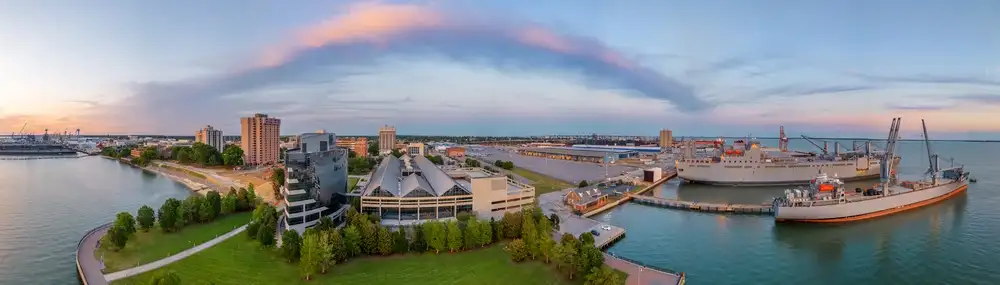
Location matters because an FTZ warehouse is most powerful when it sits close to key transportation corridors and end customers. A Midwest hub like Milwaukee places inventory within efficient reach of major population centers and manufacturing regions, while also supporting cross-border flows with Canada via road, rail, and Great Lakes shipping.
How does an FTZ warehouse work in practice?
In a typical model, imported goods arrive at a U.S. port and move in-bond to the FTZ warehouse without duties being paid at the dock. Inside the FTZ, a 3PL manages receiving, storage, value-added services, and order fulfillment under strict inventory controls and customs-compliant systems.
Duties are paid only when goods ship from the FTZ into U.S. commerce, not when they first touch U.S. soil. If certain products are exported, destroyed, or returned to the sender instead of sold in the U.S., duties may be reduced or avoided entirely, depending on the program and product classification.
Four ways FTZ warehousing cuts import costs
FTZ warehouses help importers in several practical, measurable ways.
1. Duty deferral improves cash flow
Under standard import procedures, duties and certain fees are due soon after goods arrive in the U.S., long before those products generate revenue. In an FTZ, duties are deferred until inventory leaves the zone for U.S. consumption, allowing companies to keep more cash available for operations, growth, or debt reduction.
This deferral is especially valuable for brands with longer inventory turns, seasonal products, or large safety stocks. Instead of locking money into prepaid duties on stock that may sit for months, companies align duty payments more closely with actual sales.
2. Weekly entry reduces customs fees and admin
Many FTZ operators can consolidate multiple shipments into a single weekly customs entry, instead of filing and paying fees on each shipment separately. Over time, this reduces Merchandise Processing Fees and the internal labor or broker costs associated with numerous entries.
For importers frequently replenishing inventory or running multi-origin sourcing strategies, this streamlined entry process offers meaningful savings and simplifies documentation. It also reduces the risk of entry errors because fewer, more controlled filings are required.
3. Lower inventory-related tax exposure
Depending on local regulations, inventory stored in an FTZ may enjoy reductions in certain state or local inventory taxes. For businesses holding high-value or slow-moving products - such as industrial components, machinery, or specialty goods - this can materially cut annual carrying costs.
By deliberately staging longer-term or strategic inventory in an FTZ warehouse rather than a standard facility, companies can design their network to minimise these recurring taxes. This is particularly relevant in markets where property or inventory taxes are a notable line item on the balance sheet.
4. Duty savings on exports, returns, and scrap
If goods imported into an FTZ are ultimately exported, scrapped, or returned instead of sold in the U.S., companies may avoid paying duties on those items, subject to program rules and proper documentation. This can be powerful for brands serving both U.S. and Canadian markets from the same inventory pool, as they can allocate stock dynamically without overpaying duties.
Similarly, for products that frequently require relabeling, rework, or quality holds, the FTZ framework can reduce the duty impact of damaged or unsellable goods. The key is having a 3PL partner with disciplined inventory tracking and clear processes for these exceptions.
Why a Midwest FTZ 3PL beats going it alone
Operating an FTZ is not just about filing a form; it involves strict compliance, record-keeping, technology, and coordination with customs authorities. Setting up a private FTZ for a single shipper often requires significant investment in systems, staff training, and audits.
A Midwest FTZ 3PL spreads those fixed costs across many customers while providing a ready-made, compliant environment. In Milwaukee, a logistics provider that already runs FTZ operations, temperature-controlled storage, and value-added services allows shippers to plug into FTZ benefits without building their own site.
Day-to-day advantages of an FTZ-enabled 3PL
The 3PL’s warehouse management system tracks inventory at the lot, pallet, or SKU level, satisfying FTZ audit requirements while giving shippers real-time visibility.
Dedicated staff handle FTZ procedures, customs coordination, and documentation, freeing the shipper’s team to focus on forecasting, sales, and procurement.
Integrated services such as relabeling, kitting, cross-docking, and temperature-controlled storage operate within the FTZ framework, consolidating vendors and streamlining operations.
Example journey: From port to prairie in five steps
To illustrate how this works in a real-world scenario, consider a U.S. or Canadian brand importing finished goods for distribution across the Midwest.
Step | Without FTZ (Typical) | With Midwest FTZ Warehouse |
1 | Goods arrive at U.S. port; duties and fees assessed quickly. | Goods arrive and move in-bond to a Milwaukee FTZ warehouse before duties are paid. |
2 | Inventory stored in a standard warehouse; full duty paid on entire shipment regardless of demand. | Inventory stored in FTZ; duty is deferred until each order ships into U.S. commerce. |
3 | Multiple customs entries and processing fees on frequent replenishments. | Weekly entry consolidates filings, reducing customs fees and admin time. |
4 | Inventory taxes may apply to all stored goods. | Certain inventory tax exposure can be reduced when stock sits in FTZ. |
5 | Exported, returned, or scrapped goods still carry paid duties. | Potential to avoid or reduce duties on goods not ultimately sold in the U.S. |
Is FTZ warehousing right for your business?
Not every importer needs an FTZ, but several common traits indicate a strong fit.
Checklist: you may benefit from FTZ warehousing if:
You import products with moderate to high duty rates and carry significant U.S. inventory.
Your goods often sit in storage for weeks or months before shipping, especially seasonal or safety stock.
You serve both U.S. and Canadian customers from shared inventory, or manage frequent exports, returns, or rework.
You lack in-house FTZ expertise and prefer a turnkey solution managed by a 3PL partner.
Gather your last 6–12 months of import data (volumes, SKUs, duty rates, destinations) and review it with an experienced Midwest FTZ 3PL to estimate potential saving.
How to get started with a Midwest FTZ warehouse
The first step is to understand your current duty spend, inventory patterns, and target service regions. From there, an FTZ-enabled 3PL in Milwaukee can model different scenarios - such as shifting a portion of your inbound volume into their FTZ site - to quantify cash-flow improvements and fee reductions.
For many importers, starting with a subset of SKUs or a pilot program reduces risk while delivering early savings. As the process proves out, more product lines can be transitioned into FTZ warehousing, turning “from port to prairie” into a core part of the supply chain strategy for both U.S. and Canadian brands.
Related news
View all
September 21st, 2026
Pharma and Healthcare Logistics: What Temperature Control and Traceability Requirements Actually Mean for Your 3PL
Cold storage is a starting point, not a qualification. For pharmaceutical and healthcare businesses, the real question is whether a 3PL partner meets the regulatory requirements that apply to pharmaceutical distribution - and whether their systems produce the documentation to prove it. This article covers DSCSA authorization and traceability, cGMP storage controls, international GDP guidance, pharmaceutical temperature requirements, and what a WMS needs to do to support compliant operations.

September 14th, 2026
The Hidden Costs of Getting Retail Compliance Wrong: Chargebacks, Rejections, and What Actually Prevents Them
Retail chargebacks show up as deductions. Rejected shipments show up as return freight costs and delayed revenue. Neither appears as a catastrophic single event, but the cumulative effect on margins is significant and almost entirely preventable with the right warehouse operations in place. This article breaks down what causes retail compliance failures, what they actually cost when measured honestly, and what the operational changes look like that prevent them upstream.
September 7th, 2026
Just-in-Time Warehousing vs. Safety Stock: Which Inventory Strategy Fits Your Business?
Just-in-time warehousing and safety stock represent opposite ends of the inventory strategy spectrum, and both have genuine business cases depending on demand predictability, supplier reliability, and risk tolerance. Getting the balance wrong in either direction costs money, either in excess holding costs or in stockouts and missed orders. This article explains how each strategy works, what the trade-offs are, and how to think about the right approach for your specific operation.