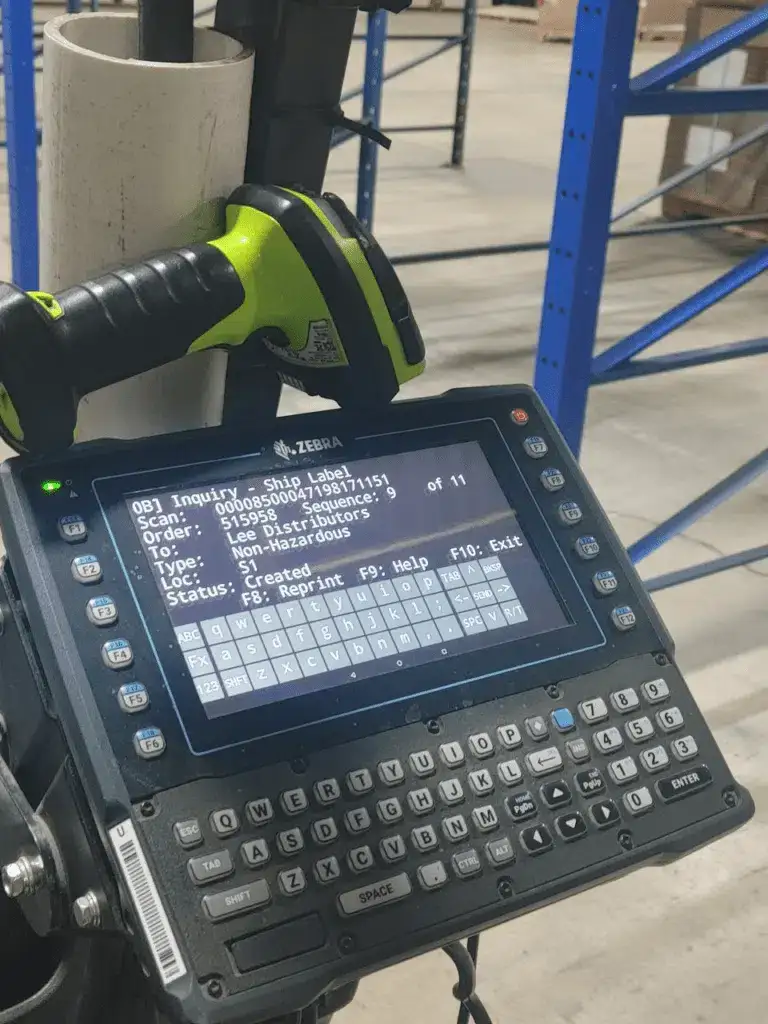
What Is a Warehouse Management System?
April 22nd, 2025
A Smarter Way to Manage Inventory, Orders, and Fulfilment
In today’s logistics landscape, visibility and efficiency aren't just “nice to have”—they're essential. Whether you’re shipping thousands of SKUs across the country or fulfilling a handful of customer orders each day, you need to know where your inventory is, what’s moving, and what needs to happen next.
That’s exactly where a Warehouse Management System (WMS) steps in.
A WMS is the digital backbone of warehouse operations. It provides the tools and data needed to manage every aspect of a warehouse - from receiving and inventory tracking to order picking, packing, and shipping. It’s the software that brings structure to physical space and turns your warehouse from a storage unit into a streamlined fulfillment engine.
Why Does a WMS Matter?
Running a warehouse without a WMS is like flying blind. You might know what’s in your building today - but can you guarantee that it’s where it should be? Can you confirm that it was picked correctly, packed accurately, and shipped on time?
A Warehouse Management System answers these questions in real time. It reduces human error, shortens pick times, and eliminates lost inventory. It ensures that every step - from the moment a product arrives at the dock to the second it leaves for a customer - is documented, optimized, and trackable.
Warehouse using a WMS experience up to 30% higher picking efficiency and over 95% inventory accuracy, according to industry research.
What Does a WMS Actually Do?
WMS Feature | How it helps |
|---|---|
Real-Time Inventory Tracking | Provides up-to-date visibility on all SKUs, reducing stockouts |
Barcode Scanning | Minimizes manual errors and speeds up receiving/picking |
Automated Replenishment | Maintains ideal inventory levels by triggering restocks |
Order Management | Streamlines the pick-pack-ship process for faster fulfillment |
Reporting & Analytics | Offers data for forecasting, labor planning, and cost control |
These features work together to ensure that your warehouse runs like a well-oiled machine - even during high-volume periods.
How Lindner Logistics Puts WMS Into Action
At our Milwaukee-based 3PL warehouse, the WMS is fully integrated into everything we do—from cold storage to Hazmat handling. It allows our team to manage complex inventory across temperature zones and product types with precision and accountability.
Every product that enters our facility is scanned and logged instantly. That gives both our internal teams and our clients real-time insight into inventory location, status, and movement. As orders come in, the WMS creates optimized pick paths and packing lists, reducing time and ensuring accuracy. Once packed, shipments are tracked through the final mile using connected TMS (Transportation Management Systems).
Lindner clients receive custom inventory reports and real-time access through a secure client portal - all powered by our WORCS system.
Common Problems a WMS Can Solve
If you're experiencing any of the following issues, it may be time to consider a WMS-driven solution:
Problem | How a WMS Solves It |
|---|---|
Misplaced or “lost” inventory | Real-time tracking and scanning reduce search times |
Stockouts and overstocking | Automated replenishment ensures balance |
Delayed order fulfillment | Optimized picking and packing streamline operations |
Poor visibility across locations | Centralized dashboard keeps multi-site warehouses aligned |
Inefficient labor use | Labor tracking and route planning boost productivity |
WMS vs. Traditional Inventory Methods
Still using spreadsheets or handwritten logs? Here's how that stacks up against a WMS.
Manual Tracking | Warehouse ManagementSystem | |
|---|---|---|
Accuracy | High risk of human error | Real-time, automated accuracy |
Labor Efficiency | Labor-intensive and slow | Optimized workflows and automation |
Inventory Visibility | Delayed or unclear | Live updates and dashboard views |
Scalability | Hard to maintain at scale | Built for growth and complexity |
Reporting & Analytics | Limited or none | On-demand insights and forecasting tools |
Final Thoughts
A Warehouse Management System isn’t just software—it’s a tool that unlocks the full potential of your supply chain. With real-time visibility, error reduction, and faster fulfillment, your warehouse becomes a competitive advantage—not a bottleneck.
At Lindner Logistics, we’ve invested in a WMS that delivers not only for us, but for our clients. Whether you're storing frozen food, Hazmat, or e-commerce goods, our system ensures your inventory is handled with precision and transparency every step of the way.
If you're ready to work with a logistics partner who brings both hands-on service and powerful tech to the table, get in touch with our team or explore our 3PL capabilities.
Related news
View all
September 21st, 2026
Pharma and Healthcare Logistics: What Temperature Control and Traceability Requirements Actually Mean for Your 3PL
Cold storage is a starting point, not a qualification. For pharmaceutical and healthcare businesses, the real question is whether a 3PL partner meets the regulatory requirements that apply to pharmaceutical distribution - and whether their systems produce the documentation to prove it. This article covers DSCSA authorization and traceability, cGMP storage controls, international GDP guidance, pharmaceutical temperature requirements, and what a WMS needs to do to support compliant operations.

September 14th, 2026
The Hidden Costs of Getting Retail Compliance Wrong: Chargebacks, Rejections, and What Actually Prevents Them
Retail chargebacks show up as deductions. Rejected shipments show up as return freight costs and delayed revenue. Neither appears as a catastrophic single event, but the cumulative effect on margins is significant and almost entirely preventable with the right warehouse operations in place. This article breaks down what causes retail compliance failures, what they actually cost when measured honestly, and what the operational changes look like that prevent them upstream.
September 7th, 2026
Just-in-Time Warehousing vs. Safety Stock: Which Inventory Strategy Fits Your Business?
Just-in-time warehousing and safety stock represent opposite ends of the inventory strategy spectrum, and both have genuine business cases depending on demand predictability, supplier reliability, and risk tolerance. Getting the balance wrong in either direction costs money, either in excess holding costs or in stockouts and missed orders. This article explains how each strategy works, what the trade-offs are, and how to think about the right approach for your specific operation.