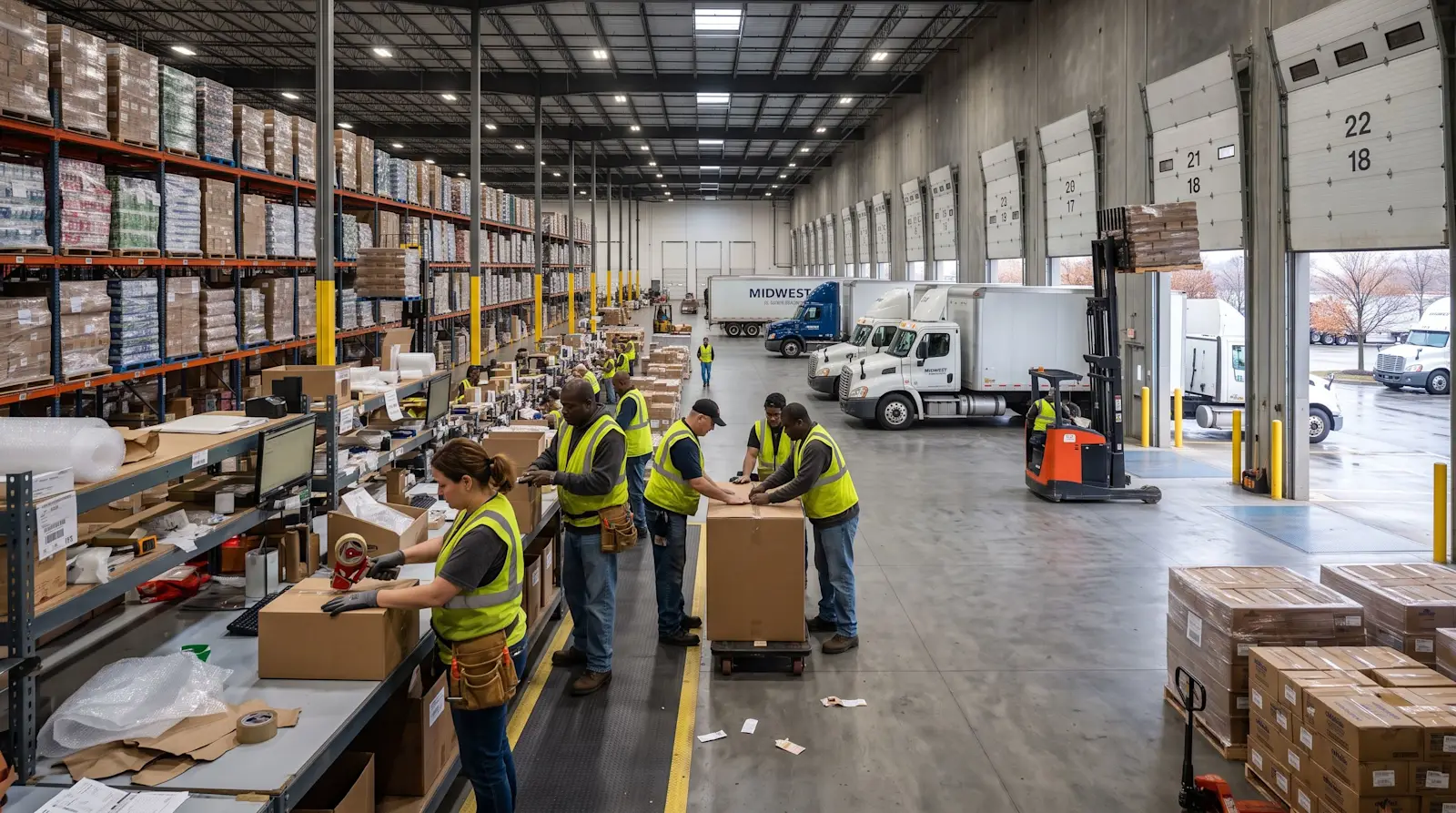
How to Prepare Your Supply Chain for Q4: A Logistics Planning Guide for Midwest Businesses
August 25th, 2026
Q4 logistics failures are rarely Q4 problems. They are August and September decisions that nobody made, capacity conversations that never happened, and compliance gaps that nobody identified until a retailer rejected a shipment in November. By the time demand spikes in October, the window to fix structural supply chain problems has already closed.
The businesses that navigate Q4 consistently well share one operational characteristic: they treat peak season preparation as a strategic exercise in late summer, not a reactive scramble in autumn. They review their logistics setup before volume arrives, identify the gaps that would become failures under pressure, and make the changes that allow the operation to absorb demand rather than break under it.
This guide covers what that preparation actually looks like for Midwest businesses, why the regional context matters for Q4 planning specifically, and how to evaluate whether your current logistics setup is genuinely ready for what peak season demands.
Why Q4 Catches Midwest Businesses Off Guard
The Midwest has specific Q4 logistics characteristics that businesses operating primarily in warmer regions do not face in the same way. Wisconsin winters arrive early and move fast, and the logistics implications of cold weather compound the demand pressures that affect every market during peak season.
Road freight becomes less reliable as winter weather disrupts transit times across Midwest lanes. Temperature-sensitive inventory that sat comfortably in ambient storage during summer may need to move into temperature-controlled environments as facility temperatures drop below product tolerance ranges.
Carrier capacity tightens as demand across all modes increases while driver availability constraints, accelerated by the 2026 FMCSA regulatory changes, reduce flexibility across the board.
On top of the regional factors, national retail compliance enforcement intensifies during Q4. Major retailers process higher volumes and enforce their routing guides, labeling requirements, and documentation standards with less manual review and more automated deduction systems. An error that might have been caught and corrected manually in June gets processed as an automatic chargeback in November.
Understanding these compounding pressures is the starting point for building a Q4 logistics plan that actually holds up under them.
The Q4 Supply Chain Planning Checklist
The following checklist covers the five areas where Q4 preparation decisions have the most direct impact on operational performance during peak season. Working through each one in August or early September leaves enough time to make changes before volume arrives.
1. Inventory Positioning and Storage Capacity
The first question is whether the right products will be in the right place at the right volume when demand arrives. Inventory positioning decisions made in September determine how quickly orders can be fulfilled in November, and a warehousing solutions partner running at or near capacity in October has no room to absorb a demand spike without disruption.
Key questions to answer now:
Are current inventory levels positioned to support the forecast demand peak without requiring emergency replenishment during the busiest weeks?
Does the warehousing partner have confirmed capacity available for the volume increase the season is expected to bring?
Are there products currently in ambient storage that will need to move into temperature-controlled environments as Midwest winter temperatures affect facility conditions?
2. Fulfillment Accuracy Baseline
Q4 amplifies whatever fulfillment accuracy rate exists in September. An operation running at 97 percent accuracy in a normal month produces three times as many errors in a month with three times the order volume. If the accuracy baseline is not strong before peak season, it will not improve under the additional pressure of higher throughput.
Key questions to answer now:
What is the current pick accuracy rate, and has it been measured systematically rather than estimated?
Are packing lists generated in real time from live inventory data, or assembled manually in ways that introduce error at scale?
Is the warehouse management system providing the real-time inventory control needed to guide picking at higher volumes without degrading accuracy?
3. Carrier Relationships and Transportation Capacity
Carrier capacity across parcel, LTL, and FTL tightens significantly in Q4, and businesses that have not confirmed capacity with their carriers or 3PL partners before October routinely find themselves competing for space at spot rates that significantly exceed contract pricing.
The 2026 freight market has tightened structural LTL capacity further, making advance confirmation more important than it was in previous years.
Key questions to answer now:
Has transportation capacity across all required shipping modes been confirmed with the carrier or 3PL partner for the October through December period?
Are there temperature-sensitive FTL loads that need to be pre-planned to ensure refrigerated trailer availability during the weeks of highest demand?
Is the documentation process for each shipping mode ready to handle higher volumes without creating compliance gaps that trigger retailer penalties?
4. Retail Compliance Readiness
Retail compliance failures are significantly more expensive in Q4 than at other times of year. Major retailers increase their enforcement of labeling standards, routing guide compliance, and documentation accuracy during peak season, often removing the manual review steps that might have caught and corrected an error earlier in the year.
Key questions to answer now:
Are GS1-128 compliant labels being produced correctly for every retail account the business supplies, with the right label type, placement, and barcode format for each partner's requirements?
Is the chargeback rate from the last Q4 understood and attributed to specific root causes, or has it been absorbed without investigation?
Does the 3PL partner have documented compliance for the specific retail accounts the business supplies, or are those requirements being managed manually?
5. Cold Chain and Temperature Planning for Midwest Winter
Midwest winter creates specific cold chain planning requirements that businesses in warmer regions do not face. Temperature-sensitive products that are stored in facilities without active temperature control during winter months may be exposed to conditions outside their specified range when ambient temperatures fall significantly below seasonal norms in Wisconsin.
Key questions to answer now:
Have all temperature-sensitive SKUs been reviewed against winter ambient storage conditions to confirm they do not need to move into active cold or freezer storage as temperatures drop?
Is the cold storage capacity available through the current 3PL partner sufficient to accommodate any products that need to shift from ambient to temperature-controlled storage during the winter period?
Are temperature monitoring and documentation systems in place to provide the continuous records that retail and regulatory auditors require, even during the higher-volume weeks of Q4?
Why Fixed Infrastructure Struggles With Q4 Demand Variability
One of the more consistent patterns in Midwest supply chain operations is that businesses running their own warehouse infrastructure face a structural disadvantage during Q4 that a 3PL fulfillment partner absorbs naturally.
Fixed infrastructure carries the same overhead whether it is operating at 60 percent capacity in August or 95 percent capacity in November. When Q4 demand exceeds what the fixed infrastructure can handle, the options are limited and expensive: emergency short-term warehouse space at premium rates, overtime labor at elevated cost, or carrier spot rates that reflect peak demand pricing rather than negotiated contract terms.
None of these solutions are available on short notice at a reasonable cost, and all of them introduce operational inconsistency at precisely the time when consistency matters most.
A 3PL partner operating at scale across multiple client accounts distributes the infrastructure cost differently, absorbing demand variability within a larger operational base without requiring the individual business to carry the fixed overhead of peak capacity year-round.
The carrier relationships that a 3PL maintains across its full client volume also provide more consistent access to capacity in a tighter freight market than an individual shipper can negotiate independently.
How to Stress-Test Your Current Logistics Setup Before October
The most practical way to evaluate Q4 readiness is to run the operation mentally through a peak week scenario and identify where the bottlenecks appear before they appear under real demand pressure.
A useful stress test works through the following sequence:
Scenario | What to Evaluate |
Order volume doubles for two consecutive weeks | Does pick accuracy hold? Does carrier capacity cover the volume? Does documentation keep pace? |
A key carrier has no available capacity for one week | Is there a backup mode or partner relationship that covers the gap without spot rate exposure? |
A major retailer issues a routing guide change in October | Can the operation update labeling and documentation protocols within the retailer's required timeline? |
A cold snap drops Midwest temperatures significantly below normal | Are temperature-sensitive products in appropriate storage? Are monitoring systems recording continuously? |
A fulfillment error results in a retailer chargeback | How quickly can the root cause be identified and the documentation to dispute it be produced? |
Working through each of these scenarios before October reveals the gaps that need to be addressed while there is still time to address them. The scenarios that produce unclear or unsatisfying answers are the ones that carry the most Q4 risk.
How Lindner Supports Q4 Logistics Planning for Midwest Businesses
Lindner Logistics provides warehousing solutions and 3PL fulfillment across Wisconsin with the operational infrastructure to support Q4 demand without the fixed overhead constraints that limit in-house operations during peak season.
Scalable storage capacity across ambient, cold, and freezer environments means that businesses managing temperature-sensitive inventory through Midwest winter have the flexibility to move products between temperature zones as conditions require, within the same operation rather than coordinating between separate providers.
WORCS, Lindner's proprietary warehouse management system, provides the real-time inventory management and pick accuracy infrastructure that maintains fulfillment performance at higher Q4 volumes, with the lot-level traceability and documentation systems that retail compliance requires during peak season enforcement. Value-added services including GS1-128 SSCC labeling for named retail partners, real-time packing lists, and order fulfillment accuracy controls are embedded in daily operations rather than managed as a separate compliance exercise.
Transportation across Parcel, LTL, and FTL is managed through the same Wisconsin 3PL operation, with established carrier relationships that provide more consistent access to capacity during Q4 than individual shipper arrangements at lower volume. As covered in our blog on why labeling, inventory control, and order accuracy define retail-ready logistics, the operational controls that prevent Q4 compliance failures are built into the daily warehouse process rather than applied as a seasonal addition.
For businesses evaluating whether their current single 3PL fulfillment strategy is positioned to handle Q4 demand, and for those reviewing the supply chain risks the holiday season introduces and how to maximize efficiency in holiday logistics operations, the August window is the right time to have that conversation rather than October.
The Takeaway
Q4 success is a function of August decisions, not October ones. The supply chain gaps that become failures during peak season are almost always visible in advance, and the window to address them is open now and closing progressively as the season approaches.
For Midwest businesses managing temperature-sensitive inventory, retail compliance requirements, and demand variability across Q4, the planning framework in this guide covers the decisions that matter most before volume arrives. The businesses that work through it now will absorb Q4 demand. The ones that do not will manage its consequences instead.
Talk to the Lindner team about Q4 logistics planning and warehousing solutions across Wisconsin, and find out whether your current distribution services setup is positioned to handle peak season demand without the structural vulnerabilities that surface under pressure.